
What type of preventive maintenance are you actually doing?
Preventive maintenance is more than just following a schedule. The real difference comes down to what signals your team to take action. Understanding these triggers can help your team stay ahead of failures instead of reacting to them.
Understanding Preventive Maintenance: The Triggers That Matter
Not all preventive maintenance strategies work the same way. Here is a closer look at the four main types:
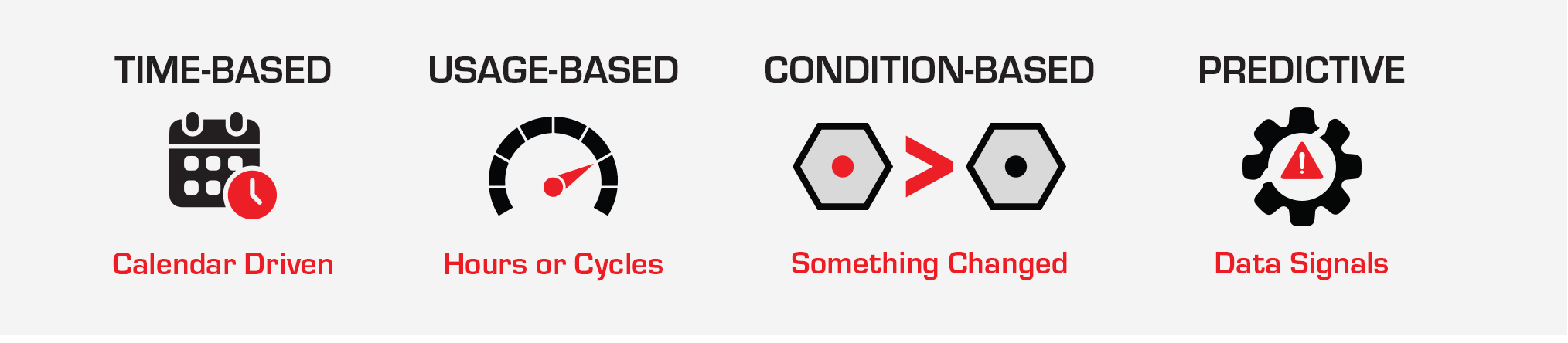
- Time-Based Maintenance
Maintenance is performed on a fixed schedule, such as weekly, monthly, or annually.
Pros: Simple to plan and ensures regular checks.
Cons: Does not account for actual equipment use and issues may be missed if they occur between scheduled checks.
- Usage-Based Maintenance
Maintenance is performed after a defined number of hours, cycles, or operational events.
Pros: Tied to actual equipment usage rather than a calendar.
Cons: Still does not consider environmental or operational conditions that may accelerate wear.
- Condition-Based Maintenance
Action is triggered by a change in equipment condition, such as vibration, temperature, wear, or tension.
Pros: Responds to actual equipment needs, catching issues before failure occurs.
Cons: Requires monitoring tools or sensors to track condition changes.
- Predictive Maintenance
Maintenance is based on data analysis and predictive models that indicate when failure is likely.
Pros: Highly efficient and allows intervention before failure occurs.
Cons: Requires advanced monitoring systems and data expertise.
All four strategies share the same goal of avoiding equipment failure, but each relies on different signals to guide action.
Why Bolted Joints Require More Than Schedules
In many industrial sites, bolted joint inspections are tied to fixed schedules or service intervals. But tension loss does not follow a calendar. It follows operating conditions such as vibration, load cycles, temperature changes, and equipment use.
A bolt may meet its installation torque specification one week but lose critical tension by the next. This small loss often goes unnoticed until it contributes to equipment failure, downtime, or damage to other components.
How SmartBolts® Align with Condition-Based Maintenance
Solutions like SmartBolts are designed for visibility-driven maintenance. Using the patented Visual Indication System™, the bolt head changes color as tension changes:
Red = loose
Black = tight
This allows maintenance teams to:
- Verify clamp force during routine inspections
- Identify minor tension loss before it causes failure
- Prioritize joints that require re-tensioning
- Reduce unnecessary blanket torque checks
No heavy systems. Just clear, actionable signals that align perfectly with condition-based maintenance.
Making Maintenance Smarter
Maintenance decisions are only as good as the data you can see. By monitoring tension visually, teams can move from purely schedule-driven checks to proactive, condition-aware inspections. This approach allows minor issues to be addressed before they become costly failures.[wpcode id=”9488″]

