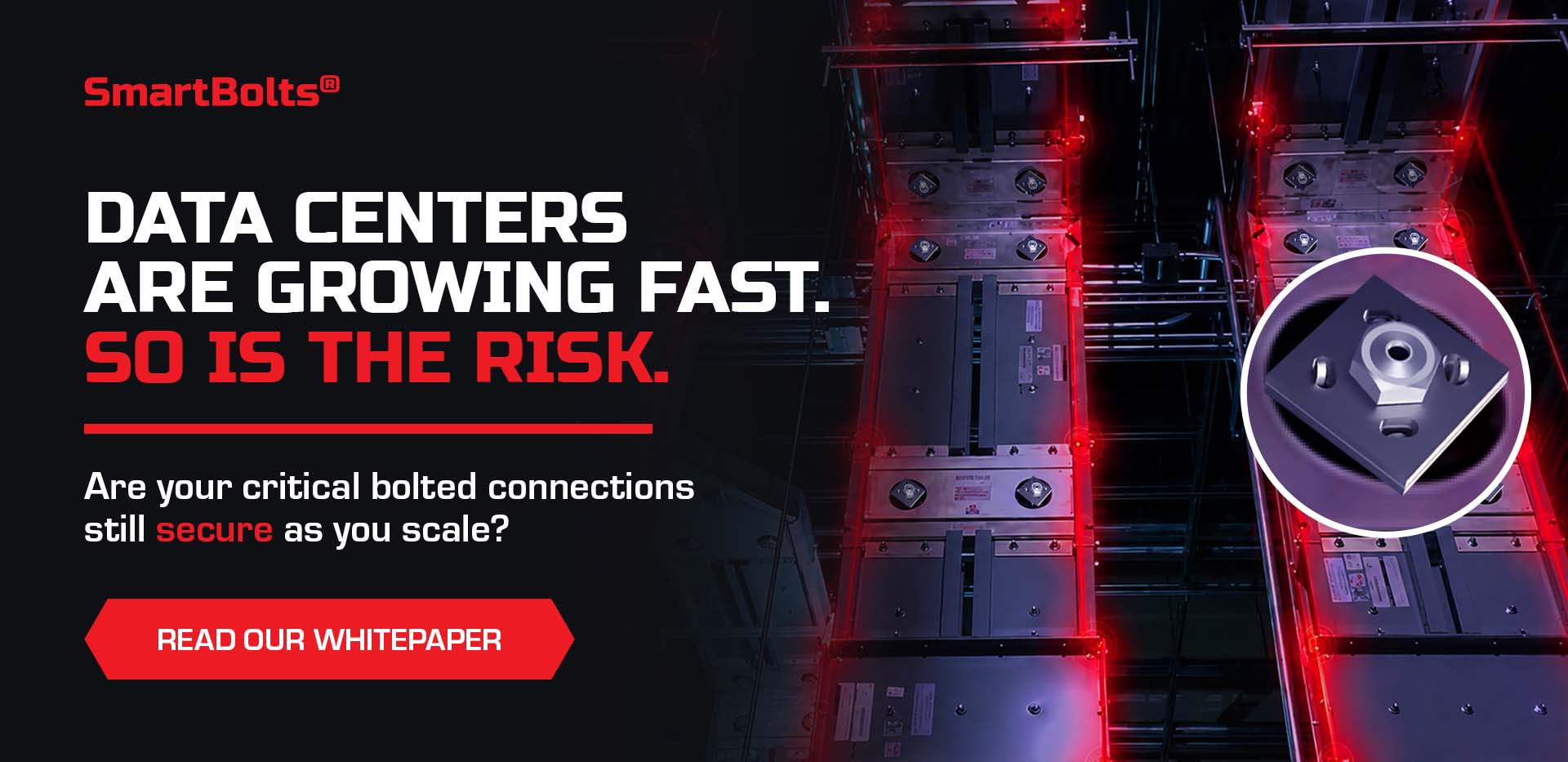
Up to 50% of busway failures can be traced back to insufficient bolt tension.
As data centers scale to support AI, cloud infrastructure, and high-performance computing, power distribution systems are operating under increasing demand. Busway systems have become the preferred solution for delivering scalable, high-capacity power, but they also introduce a hidden reliability risk that many facilities still overlook.
At the center of this issue is bolted joint integrity.
Most maintenance programs continue to rely on torque-based installation and inspection methods. The problem is that torque does not directly measure clamp force. It only estimates it. Even with calibrated tools and proper procedures, actual bolt tension can vary significantly due to friction, lubrication, surface conditions, installer technique, and other variables.
That means a connection can appear secure during installation while still carrying insufficient clamp force in operation.
The Hidden Risk Inside Busway Systems
In high-density environments, even a minor loss of bolt tension can have serious consequences.
As connections loosen over time through thermal cycling and vibration, electrical resistance begins to increase. This can lead to:
- Heat buildup
- Conductor degradation
- Insulation damage
- Arc fault risk
- Unplanned downtime
The challenge is that these failures often remain invisible until the damage has already started.
Traditional inspection methods like infrared thermography typically detect problems only after excessive heat is already present. By that stage, the connection may already be deteriorating.
Our latest whitepaper introduces a concept called the Connection Integrity Gap—the difference between the bolt tension maintenance teams assume is present and the tension actually achieved in the joint.
As data center infrastructure scales, this hidden risk scales with it.
Why Torque Alone Is Not Enough
Torque has long been treated as the industry standard because it is measurable and repeatable. However, torque measures rotational resistance—not actual clamp force.
The whitepaper explores why torque-based tightening can produce up to ±35% variation in achieved clamp force, even under controlled conditions.
This creates two major risks:
- Undertension, which can allow joints to loosen under load
- Overtension, which can damage fasteners or compromise joint integrity
Both conditions can produce identical torque readings.
Moving From Assumption to Verification
Instead of relying on assumptions, SmartBolts® provide direct visual verification of proper bolt tension.
Using a patented Visual Indication System™, SmartBolts® change color based on achieved tension:
- Red indicates insufficient tension
- Changing from red to black indicates increasing tension
- Black indicates proper design tension
This allows maintenance teams to instantly verify busway joint integrity during routine inspections without additional tools, live testing, or disruptive maintenance procedures.
The result is a faster, more proactive approach to identifying connection issues before they escalate into failures.
What You’ll Learn in the Whitepaper
In Eliminating Hidden Connection Risk in Data Centers, we explore:
- Why bolt tension can vary by ±35% even with calibrated torque tools
- How loose joints increase resistance, heat buildup, and arc fault risk
- Why torque does not directly measure actual clamp force
- The Connection Integrity Gap and how it creates hidden reliability risks
- How SmartBolts® provide instant visual confirmation of proper bolt tension
Download the whitepaper now to learn how data centers are shifting from assumption-based maintenance to verification-based reliability.

