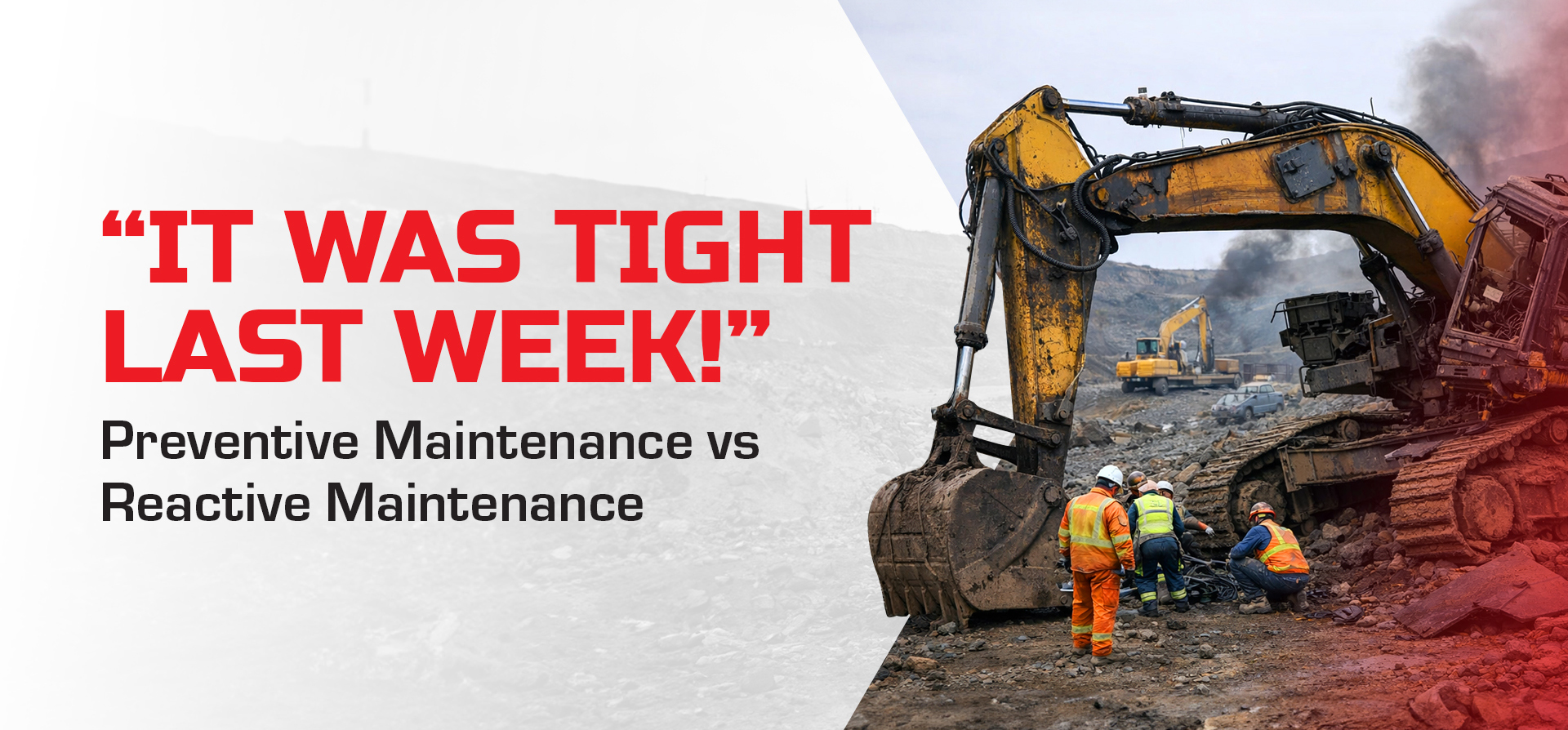
“That bolt was tight last week.”
Every maintenance crew has said it.
And every site has paid for it.
Bolted connections rarely fail without warning. More often, small losses in tension go unnoticed until vibration, load cycles, and operational stress turn them into equipment failure and downtime.
The real difference between reactive and preventive maintenance often comes down to one thing: Visibility.
What Is Reactive Maintenance?
Reactive maintenance means responding after a problem has already developed. Something breaks. Production stops. A crew is mobilised. The issue is diagnosed and corrected.
In bolted joints, this often looks like:
- A component loosening
- A joint separating
- A leak forming
- A structural element shifting
- Equipment failing unexpectedly
The repair happens after performance has already degraded.
How Normal Bolts Enable Reactive Behaviour
Traditional bolting relies heavily on torque as the installation verification method.
Torque is not tension. Torque is the rotational force applied to generate bolt stretch.
The issue is that torque is an indirect measurement. It does not directly confirm clamp force. It assumes that:
- Friction levels are consistent
- Lubrication is controlled
- Surfaces are uniform
- Installation technique is accurate
In many bolted joints, as much as 85 to 90 percent of applied torque can be lost to friction, leaving only a small portion to generate actual bolt tension.
A bolt can meet torque specification and still:
- Be under-tensioned
- Lose clamp force early
- Experience embedment relaxation
- Begin loosening under vibration
Because torque was achieved, the joint is assumed to be secure. That doesn’t mean it is. This assumption is what drives reactive maintenance.
Hidden Costs of Reactive Maintenance
When bolt tension is invisible, problems are discovered late. The consequences are rarely limited to the bolt itself.
Reactive maintenance often results in:
- Emergency labor callouts
- Production downtime
- Exposure to hazards
- Secondary component damage
- Accelerated asset wear
- Disrupted schedules
The bolt is inexpensive. The failure rarely is.
In many cases, the root cause traces back to clamp force loss that went undetected.
What Is Preventive Maintenance?
Preventive maintenance identifies and addresses early warning signs before failure occurs.
Instead of asking, “What broke?”, it asks, “What is changing that we need to be aware of?”
In bolted joints, the critical variable is tension. Tension creates clamp force, and clamp force holds the joint together. If tension drops, joint integrity drops.
Preventive maintenance requires the ability to verify that tension remains within specification, not just at installation, but throughout operation.
How SmartBolts Facilitate Preventive Maintenance
SmartBolts replace torque-based assumption with direct visual tension verification. Through the patented Visual Indication System™, the bolt head changes colour as bolt stretch changes:
Red = loose Black = tight
This colour shift corresponds to actual bolt elongation, which directly relates to tension.
Maintenance teams can:
- Confirm clamp force during routine inspections
- Identify minor tension loss early
- Prioritise joints that require re-tensioning
- Avoid unnecessary blanket re-torquing
- Reduce reliance on repeated torque checks
Instead of discovering failure after performance changes, teams gain early visibility into joint condition.
This shifts maintenance from reactive to preventive.
| Reactive Maintenance | Preventive Maintenance |
| Verifies torque at installation | Verifies tension directly |
| Assumes clamp force | Confirms clamp force |
| Detects issues after performance changes | Detects tension loss before failure |
| Requires shutdown to investigate | Allows visual checks during routine walkdowns |
| Drives emergency response | Enables planned intervention |
Torque vs Tension: The Operational Difference
Torque is a method.
Tension is the outcome that matters.
When tension is visible, maintenance decisions improve at the connection itself.
[wpcode id=”9488″]
